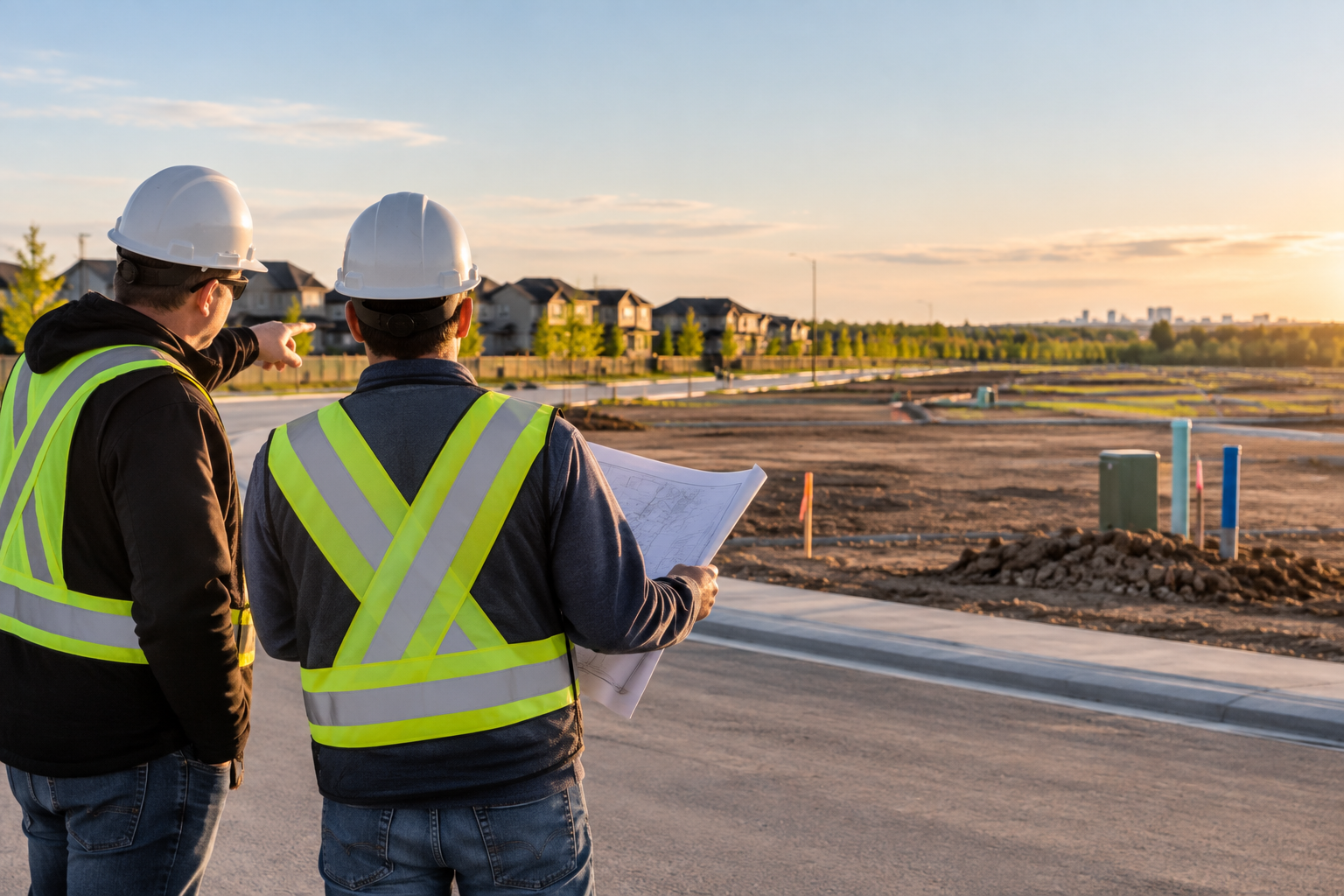
For builders evaluating builder-ready lots in Edmonton, the most important question is not simply whether a lot exists on a subdivision plan, but: Can a builder move forward with confidence?
A lot can be part of an approved development and still require significant work before construction can begin. Servicing, infrastructure, municipal approvals, registration, development phasing, and delivery schedules all affect when a builder can realistically take possession and begin the next stage of work.
At Saga Development, our role is to create the conditions that allow builders to move forward. We acquire, plan, develop, service, and prepare land so builders can construct homes within those communities.
So, what actually makes a lot builder-ready?
1. The land is more than just “approved”
Approvals are an important milestone, but approval alone does not necessarily mean a lot is ready for construction.
Residential development involves multiple stages, including planning, subdivision, zoning, permitting, engineering coordination, municipal processes, servicing agreements, and infrastructure development. For a builder, it is essential to know where a particular lot sits within that process. A lot that is still moving through planning or approvals may have potential, but it is different from a lot that has progressed through the development process and is approaching construction readiness.
Builders evaluating lots in Edmonton should look beyond a simple “approved” or “available” label. Understanding the development stage is critical.
2. Servicing and infrastructure are in place – or properly sequenced
A builder-ready lot needs more than a legal parcel of land; it also needs the infrastructure and servicing required to support construction. This is one of the biggest differences between raw land and genuinely construction-ready land. Saga’s development work includes coordinating roads and utilities, stormwater and servicing considerations, engineering, infrastructure, and servicing agreements.
For builders, infrastructure readiness can affect:
- When construction can begin
- How lots can be accessed
- How development phases progress
- Whether utility connections can be coordinated
- How confidently construction schedules can be planned
Servicing is part of what makes the lot usable. When evaluating builder lots in Edmonton, builders should ask not only whether servicing is planned, but what stage that servicing has reached and how it fits into the broader development sequence.
3. The development has a clear phasing strategy
Large residential communities are rarely delivered all at once.
Multi-phase development requires careful sequencing so that land, infrastructure, approvals, and servicing progress in a practical order. Saga specifically works with multi-phase development planning and development phasing as part of its land development process.
For builders, phasing provides an important piece of the bigger picture.
A builder may be interested in a particular lot today, but what happens around that lot matters too. Infrastructure, access, servicing, adjacent development, and future lot delivery can all be influenced by the phase in which the lot is located.
A well-planned development gives builders more than individual lots. It provides a clearer path from land development to construction.
4. Delivery timing is realistic and understandable
For builders, timing matters.
A lot that is technically part of a future development is not the same as a lot that can be delivered when the builder needs it. That means a useful builder conversation should go beyond asking, “How many lots are available?”
The better questions are:
- What stage is the development at?
- What servicing work remains?
- How is the development phased?
- What approvals or agreements are still outstanding?
- When is the relevant phase expected to be ready?
- How does lot delivery fit within the overall development schedule?
These questions help distinguish a future opportunity from a lot that is approaching genuine construction readiness.
5. The developer understands the builder’s requirements
Builder-ready land is not created in isolation. Land developers, builders, municipalities, planners, engineers, consultants, contractors, and other industry professionals all play roles in the development process.
For Saga, builder partnerships are part of that development model. The goal is to prepare appropriately planned, fully serviced, builder-ready lots while coordinating with builders throughout the development process.
That creates an important distinction: Saga is not competing with builders to construct homes. Saga prepares the land; builders build the homes. For a builder assessing residential lots for builders in Edmonton, understanding that division of responsibility can make the development process much clearer.
What should builders look for when evaluating a lot?
A genuinely builder-ready opportunity should be evaluated as part of the entire development process, not just by looking at the lot itself. A practical evaluation should consider:
- Servicing: Are the required infrastructure and utilities being delivered, and where does the lot sit in that process?
- Approvals: What planning, zoning, permitting, registration, or servicing steps have been completed?
- Phasing: Which development phase contains the lot, and how does that phase fit into the larger community plan?
- Delivery: Is there a clear and realistic path to lot availability?
- Developer coordination: Does the developer understand the builder’s requirements and communicate regularly throughout the development process?
These factors help turn the phrase “builder-ready” into something meaningful.
Builder-ready starts with development work
The finished lot that a builder can work with is the result of a much larger process. Saga’s approach begins with land planning and continues through subdivision, municipal coordination, approvals, engineering, infrastructure, servicing, registration, phasing, and preparation of construction-ready lots.
For builders and development partners, the value is not simply having land available. It is having a development partner focused on creating the infrastructure, approvals, servicing, and delivery conditions needed to move the project forward.
If you are evaluating a Saga development or want to discuss a potential builder opportunity, the next step is to contact Saga’s development team.
Frequently Asked Questions
What is a builder-ready lot?
In practical terms, a builder-ready lot has progressed far enough through planning, approvals, servicing, and infrastructure work for the builder to move toward construction.
Are approved lots automatically builder-ready?
No. While approval is one part of the development process, servicing, infrastructure, registration, phasing, and delivery timing also need to be considered.
Does Saga build homes?
Saga is a land developer, not a builder. Saga develops and services land and prepares builder-ready lots; builders construct homes within Saga developments.
Why does development phasing matter to builders?
Phasing helps establish the sequence in which infrastructure, servicing, and lots are delivered. This gives builders a clearer understanding of how a particular lot fits into the larger development.
What should a builder ask before evaluating a lot?
Builders should ask about the development stage, servicing, approvals, infrastructure, phasing, and expected delivery timing. These details provide a better picture of whether a lot is genuinely ready for construction.